
Diamonds Power: Hold and Win Review: One Bolt, Two Jobs and 4,439 Demo Spins
Diamonds Power: Hold and Win came out of Playson in November 2023 on a three-reel chassis this portal knows well. Royal Joker, Royal Coins 2 and Thunder Coins run on the same one, and all three have a book here. A golden bolt lands on the middle reel only and does two jobs. Beside a diamond in the base game it pays the diamond's value on the spot, and inside the Bonus Game it sticks and adds every new diamond to its own total. The SlotLab testing team holds two logs of it at a flat 1.00, 4,439 paid spins together, which returned 93.65% with eighteen rounds and a 231-bet best round. This portal's own log ran 2,738 paid spins, collected 484.00 through the bolt between rounds, paid 971.00 inside twelve of them and closed at 94.78%. The screens print no return, no volatility label and no maximum, so the card takes its return and its volatility from the guide Playson writes for operators and leaves the maximum at Not verified. The review below is about the one symbol and what each of its jobs is worth.
- Who it suits: players who want a three-reel coin board whose collector also pays between rounds, one collection per 43 spins in our log, and who accept lines that pay on fewer than one spin in eleven
- Core mechanic: a golden bolt on the middle reel with two jobs: beside a diamond in the base game it pays the diamond's value at once, and inside the respin round it sticks and adds every new diamond to its own total, a second and third bolt counting each diamond again
- Key risk: the wait between rounds, which reached 540 paid spins in our log; no return, no volatility label and no maximum printed in the build or on the studio's page, only in a guide for operators that lists four return settings; a GRAND at 1,000x above the reels with no odds, and a Diamond Pile feature that runs on a count the screen never shows
- Rating: 6.8/10
Game Information
93.65% tested, pooled on paid spins
231x tested, best full round (all sessions)
Where the stated figures come from
| Figure | Value | Source | Checked | In the tested build |
|---|---|---|---|---|
| Stated RTP | 95.66% | Playson's game guide for operators (PDF, 16 pages, a Romanian copy hosted by an operator), page 4: four return settings, 90.00%, 92.66%, 94.66% and 95.66%, a hit frequency of 10.90% and the game IDs diamonds_power and diamonds_power_mob; the card carries the highest setting. No RTP is printed on the public demo's Game Info pages, on its panel or in the session's configuration, and the studio's page for the game, read from an archived copy, gives the release date, the grid and the line count and no return. Third-party databases are listed separately below. (game page) | guide read 7 November 2026; public demo 6 November 2026; archived studio page of 12 December 2024 read 6 November 2026 (direct access returns an error); archived screens 26 May 2026 | No: the build prints no return, so which of the four settings it runs is unconfirmed |
| Advertised max win | Not verified | Hard cap not established: no maximum is printed in the rules and no cap ends a round, and the studio's guide for operators prints only a simulation figure with no unit (separate row). The intro screen and the first rules page draw a 1,057x collection as an illustration (a GRAND at 1,000x, a MINOR at 50x and a 7x diamond), and third-party databases quote that figure as a maximum (rules page) | public demo 6 November 2026; archived screens 26 May 2026; guide read 7 November 2026 | No: the build prints no maximum and no cap; its largest printed figure is the GRAND at 1,000x |
| Volatility | Medium-High | Playson's game guide for operators, page 4: volatility 7.59, medium to high. No label is printed in the build or on the studio's page, and third-party databases disagree between medium and high | guide read 7 November 2026; build and studio page 6 November 2026 | No: no label in the build |
| Simulation maximum (studio guide) | 5150, unit not specified in source | Playson's game guide for operators, page 4: the maximum payout observed over 50 billion spins is printed as 5150, with no unit in that cell and no route to the figure named; the document sets no hard cap, so the card's max win stays Not verified | guide read 7 November 2026 | No: a simulation figure from the guide, not read from the build |
| Bonus trigger | A diamond on reels 1 and 3 with the Power Bonus bolt on reel 2 (Diamond Pile can top up) | In-game rules: the Bonus Game starts when there is at least one Bonus symbol on each reel, Bonus diamonds land on reels 1 and 3 only and the Power Bonus lands on reel 2 only; restated on our rules page (rules page) | public demo 6 November 2026; all 18 logged rounds opened that way, six of them through the Diamond Pile | Yes: printed in the rules; no rate printed |
| Jackpots | MINI 25x, MINOR 50x, MAJOR 150x, GRAND 1,000x | In-game rules, Bonus Game Jackpots page, and the panel over the reels, each a diamond that the bolt collects like any other | public demo 6 November 2026 | Yes: printed in the rules and on the panel; no odds printed |
| Release date | November 9, 2023 | Playson's game page, release-date field, read from an archived copy of 12 December 2024; a trade announcement of the launch is dated 9 November 2023. Direct studio access returns an error, and the build prints no date (game page) | archived studio page and announcement read 6 November 2026 | No: the build prints a version line, VER 1.26.0 on 6 November 2026, and no release date |
| Third-party listings (unverified) | 95.66% RTP and 1,057x on several; volatility medium on some, high on others | Third-party databases that name no configuration; the 95.66% matches the top of the four settings in the studio's guide, and the 1,057x matches the sum drawn on the build's intro screen rather than any figure in the guide | 6 November 2026 | No: not verified for the tested build |
Where a figure is our reading of a source, the row says so.
One symbol with two jobs, and the sums each job left in the log
Diamonds Power: Hold and Win is a three-reel Playson board with one working part, a golden bolt the rules call the Power Bonus. It lands on the middle reel only, and it has two jobs. In the base game it collects the value of every diamond standing on the outer reels and pays the sum at once, on that spin. In the Bonus Game it sticks to the middle reel and adds each new diamond to its own total. When the respins run out, every bolt on the reel is paid. The same bolt therefore earns in two currencies, small change between rounds and a lump at the end of one. My log of 2,738 paid spins at 1.00 lets me weigh the two against each other, which is what this review is for.
The first job paid 484.00 over 64 collections, one collection per 43 paid spins, and that is 17.68% of everything I staked. The second job paid 971.00 across twelve rounds, 35.46% of the stakes, with the largest round worth 231 bets. The lines added 1,140.00 on their own, and the whole log closed at 94.78%, 143.00 under its start. A sister log on diamondspowerslots.com ran 1,701 spins and closed at 91.83%, so the pool stands at 4,439 paid spins and 93.65%. Every figure below is read from the game's own settlement of each spin, and the two logs are added by money.
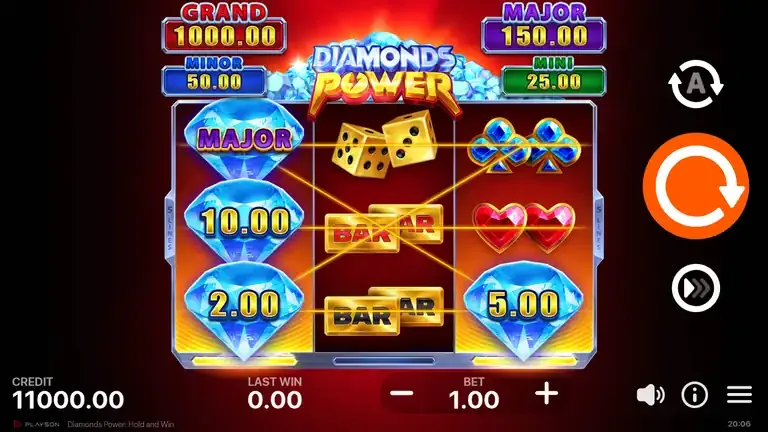
Twelve rounds, and the limits that come with them
A single demo wallet at one stake with twelve rounds in it (n = 12) is all the evidence I hold myself, so the limits go first. The exact Poisson interval at 95% puts the round clock as slow as one round in 442 paid spins or as fast as one round in 131, with my log at one in 228. The pool's eighteen rounds pull that band to between one in 156 and one in 416, slower at both ends than any pooled clock on our Hold and Win shelf. Twelve rounds show how a round is put together, and they don't say how often the GRAND arrives, since no GRAND and no MAJOR diamond landed in the eighteen. Nothing on the screens prices the game either, which is the second limit. Nowhere in the client can a player find a return figure, a volatility label or a maximum win, and the studio's public page offers a release date, a grid size and a line count. The prices exist, in the guide Playson writes for the casinos that run its games, as four return settings from 90.00% to 95.66%, a volatility of 7.59 on the studio's own scale, and a bare 5150 as the best payout of a long simulation, with no unit beside it. No page says which of the four settings my demo ran, so the card carries the top return setting and the label, names their source, and leaves the maximum at Not verified. One more limit belongs here: the game's record carries a counter that no screen shows, and the log says what it counts without saying what it changes.
Five lines, two colours of BAR, and nothing paid under the stake
Three reels, three rows and five fixed lines, three straight and two diagonal, each paying when three of a kind run from the left reel. A line pays its best combination only, and the paying lines of one spin are summed together. The red 777 serves as the wild for every ordinary symbol, and it never stands in for the diamond or the bolt. The prices below are the build's own paytable at 1.00, the stake our log ran at.
| Symbol | Three on a line at 1.00 | In bets |
|---|---|---|
| 777 wild | 50.00 | 50x |
| Bells | 30.00 | 30x |
| Dice | 20.00 | 20x |
| BAR, red lettering or black lettering | 16.00 | 16x |
| Hearts, green gems, purple spades | 4.00 | 4x |
| Blue clubs | 1.00 | 1x |
The public demo printed these values at a 1.00 bet on 6 November 2026. The paytable page shows the red BAR and the black BAR together under one price, and the game's reel strips carry them as two different symbols. A line of three clubs returns the stake exactly, and no line pays less.
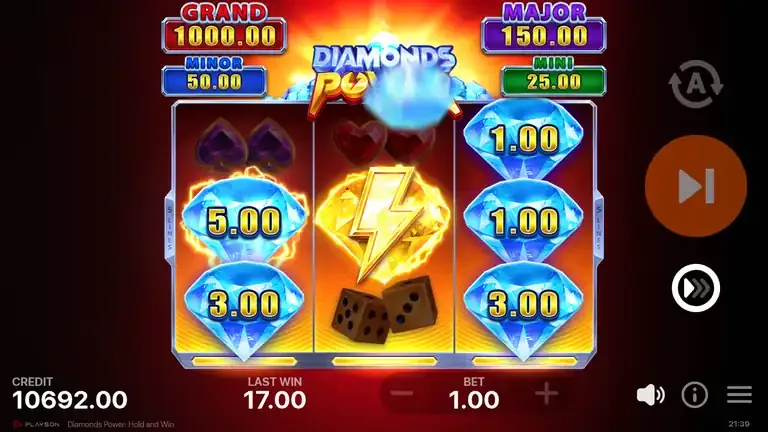
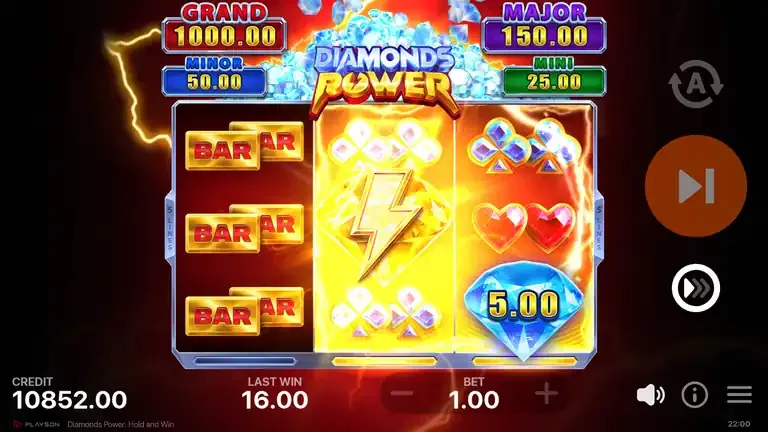
The two BARs are the detail worth a sentence of their own. Three red BARs pay 16.00 and three black BARs pay 16.00, and a line that mixes the two colours pays nothing at all. My log holds nineteen such mixed lines and not one of them paid, whereas the nine BAR lines that paid were all one colour or completed by a wild. The screen that prices them gives no hint of the rule, and a player reading the two tiles as one symbol will count wins that never come. The rest of the paytable is plain, and its one rule is the smallest line. Three clubs give the stake back, and nothing on the board pays less than that. My log's 304 base-game payments, lines and collections together, all came in at the stake or above, and 49 of them were a lone line of clubs at exactly 1.00. What that rule costs is frequency: the lines paid on 240 of the 2,738 spins, under one spin in eleven. A payment of 4.00 was the usual one, 134 times over, and 130 of those were a single line of low symbols, three of them a bolt collecting two small diamonds, and one a board of clubs that paid on four lines at once. The largest was 34.00 from hearts on the top row and bells with a wild on the middle one.
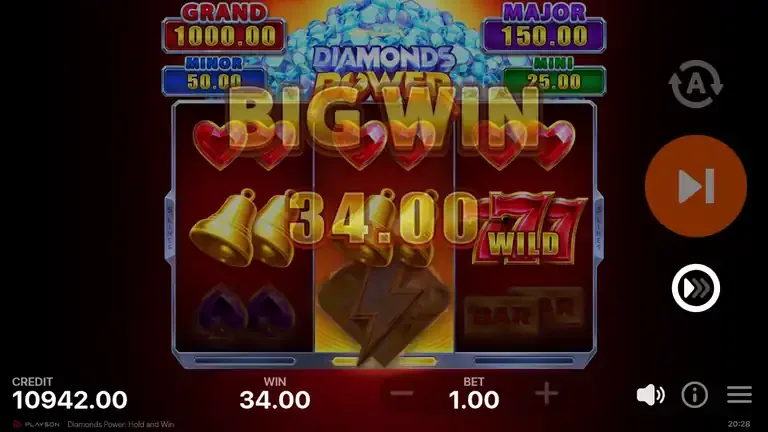
The bolt in the base game, and the MINI it took on the way
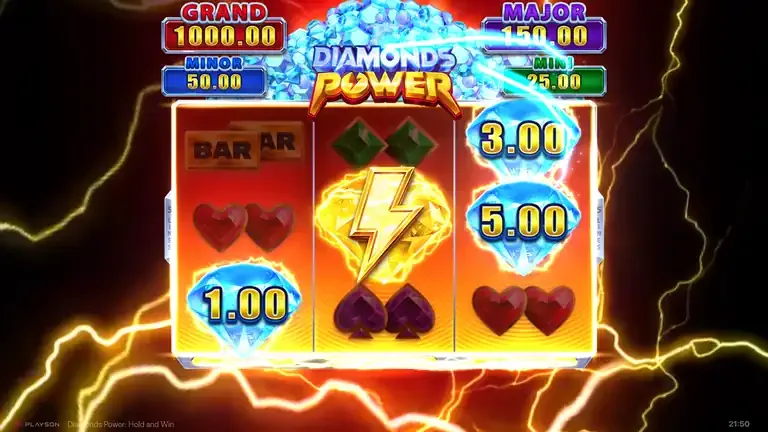
Every diamond on the outer reels wears a value, 1x to 15x of the bet on the common ones and 25x, 50x, 150x or 1,000x on the four jackpot diamonds. In the base game that value is a picture until a bolt stands on the middle reel beside it, and then it is paid on the spot. The rules call this the Diamonds Power Feature, and the log shows it as a small, regular event. It paid 64 times in 2,738 paid spins, a median of 7 bets and a mean of 7.56. The largest collection took 32 bets on the 191st paid spin, from a 7.00 diamond and a MINI worth 25.00 standing on the right reel. The 64 collections came to 484 bets, 18.65% of everything the log returned, and no collection coincided with a line win on the same spin. The sister log collected 35 times in 1,701 spins, one per 49, with 23 bets as its best. The two jobs of the bolt meet on one spin only when diamonds stand on both outer reels, and then the round opens instead of the collection. It happened on none of my 64 collecting spins and on all twelve of my rounds.
The rest of the diamonds are scenery, and there's a lot of it. A diamond or a bolt stood on the board on 1,091 of my 2,738 spins, and the diamonds that no bolt reached were worth 4,577 bets, none of it paid. A MINI diamond sat on the base-game board fourteen times, a MINOR three times and a MAJOR once. Only one MINI of those eighteen was ever collected, by the bolt on the 191st spin. The 416 spins that showed a bolt and no diamond paid nothing for the bolt either. On paper, the collection makes the base game busier than the board next door. In the sample, it moved the base-game return to 59.31% of the stakes, with the lines alone at 41.64% and the bolt at 17.68%. The figure sits above every base game on our base game against bonus page.
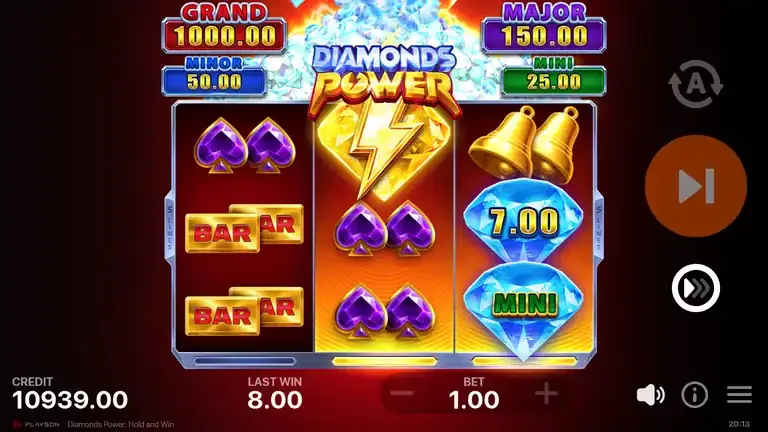
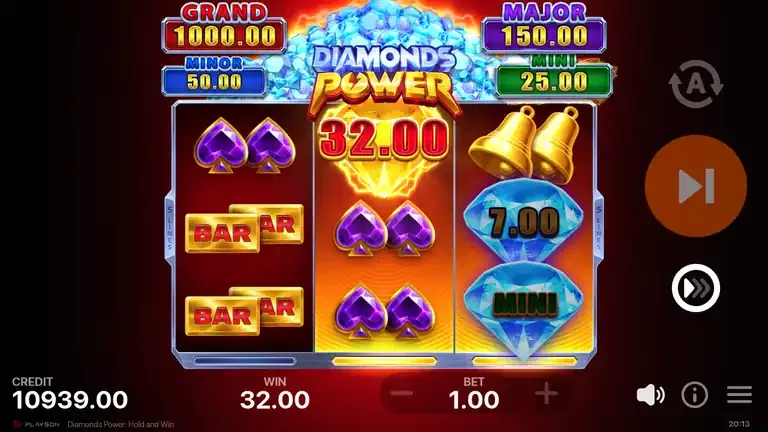
The round: three respins, bolts that stay, diamonds that leave
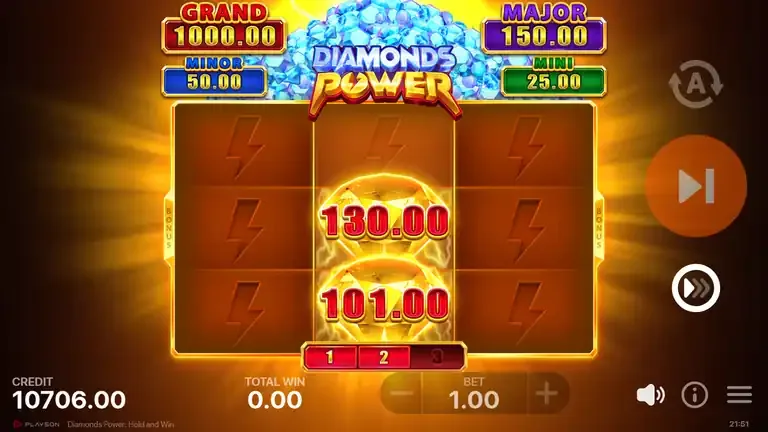
The Bonus Game needs a diamond on the left reel, a bolt in the middle and a diamond on the right, rows irrelevant. The board then clears, nothing but diamonds and bolts can land, and three respins are granted, the count refilled to three by every new symbol. A bolt that lands sticks to the middle reel; when a diamond drops, each bolt on the reel adds its value and the diamond leaves the board. A second and a third bolt can land and stick, each starting from nothing. A diamond that falls under two bolts is therefore counted twice, and under three bolts three times. Once the counter is spent, the totals on the bolts are added together and paid. My twelve rounds follow in the order they arrived, each payout matched to the cent with the totals on its bolts.
| Round | Trigger spin | Respins played | Diamonds landed | Diamond value | Bolts at the close | Round payout | Payout ×bet |
|---|---|---|---|---|---|---|---|
| 1 | 340 | 12 | 13 | 72.00 | 72.00 + 21.00 | 93.00 | 93x |
| 2† | 598 | 11 | 12 | 72.00 | 72.00 + 7.00 | 79.00 | 79x |
| 3 | 672 | 9 | 10 | 64.00 | 64.00 | 64.00 | 64x |
| 4 | 1,212 | 12 | 9 | 23.00 | 23.00 + 9.00 | 32.00 | 32x |
| 5 | 1,415 | 21 | 17 | 74.00 | 74.00 + 3.00 + 3.00 | 80.00 | 80x |
| 6† | 1,452 | 14 | 13 | 43.00 | 43.00 + 31.00 + 0.00 | 74.00 | 74x |
| 7 | 1,780 | 10 | 11 | 68.00 | 68.00 | 68.00 | 68x |
| 8 | 2,120 | 19 | 14 | 69.00 | 69.00 + 3.00 | 72.00 | 72x |
| 9 | 2,184 | 6 | 8 | 40.00 | 40.00 + 16.00 | 56.00 | 56x |
| 10† | 2,247 | 11 | 14 | 49.00 | 49.00 + 28.00 + 12.00 | 89.00 | 89x |
| 11 | 2,515 | 12 | 15 | 130.00 | 130.00 + 101.00 | 231.00 | 231x |
| 12† | 2,673 | 7 | 8 | 31.00 | 31.00 + 2.00 | 33.00 | 33x |
| 12 rounds | one per 228 paid spins | 144 | 144 | 735.00 | one in 2 rounds, two in 7, three in 3 | 971.00 | 80.9x average |
Trigger spins count paid spins from the first stake, as the session report's checkpoints do. A dagger marks the four rounds that the Diamond Pile feature opened. Diamond value adds up the faces of every diamond that landed, each counted once, and the bolts stand in the order they arrived. Six of the twelve rounds paid 73.00 or under, with a mean of 80.92 across all twelve.
Two rounds closed on the bolt they started with, and each paid the faces of its diamonds and not a bet more, 64 and 68. The ten rounds that closed on two or three bolts paid 839 bets on diamonds worth 603. The 236 bets of difference are the diamonds counted a second or a third time, a quarter of all the round money. The pool's best round is my own, and it shows the rule at its cleanest. The trigger came on the 2,515th paid spin, a 1.00 diamond on the left, a bolt in the middle and diamonds of 3.00 and 5.00 on the right. A second bolt landed on the third respin, and from then on every diamond fell under both. Fifteen diamonds worth 130 came down in twelve respins, a MINOR at 50.00 and a MINI at 25.00 among them, and the two bolts closed at 130.00 and 101.00. The 29 bets between them are the diamonds that fell before the second bolt arrived. The round paid 231.00, and the meter moved from 10,706.00 to 10,937.00 in one credit.
A late bolt buys little and an early one buys a second count of everything. The third bolt of my sixth round arrived on the eleventh respin and closed at nothing. The second bolt of the eleventh round arrived on the third respin and took 101 of the round's 231 bets. The longest round ran 21 respins and paid 80 bets on three bolts, two of which had arrived too late to see more than 3.00 each. Across the pool the eighteen rounds landed 210 diamonds worth 1,039 bets and paid 1,456. Nine of the eighteen closed on two bolts, five on three and four on one.
The Diamond Pile, and the counter nobody sees
Four of my twelve rounds were not opened by the reels, and the rules have one sentence on how that happens. The Diamond Pile feature can fire on any base-game spin that lands a diamond, in the rules' words, and it adds diamonds and a bolt until a round can start. All four of mine fired with one or two diamonds standing and no bolt, and each time the pile dropped a bolt and enough diamonds for the trigger. The sister log holds two such rounds in six, so the pool has six of them in eighteen. Those six paid 79, 74, 89, 33, 164 and 32 bets, the same spread the natural rounds show. The rules give the feature no odds; the intro screen says nothing about it.
The record behind the game keeps a count that the screen never draws. It rose by one on 40 spins, every one of them a spin that showed a diamond or a bolt, and never on a spin that showed neither. It stopped at nine, where it sat for 1,849 of my 2,738 spins. It fell back to nought on exactly four spins, the four on which the pile fired, and each of those four found it at nine. The sister log shows the same count reset twice, once from five and once from nine. I would expect the pile to be tied to that count in some way, and I can't say how, because nothing on the screens or in the rules describes it. A feature sold as a chance, with a count behind it that nobody can read, belongs under disclosure, and the deductions at the end treat it that way.
The other 2,726 spins
With the twelve settlements counted in, 315 paid spins out of 2,738 returned something, 11.50%, and the lines and collections together paid on 304, 11.10%. The longest run with nothing back was 50 spins, ending at the 1,002nd. The balance line of the session has a long slope in the middle and a late lift at the end. The 93, the 79 and the 64 all came before the 672nd spin, and they put the meter at 11,069.00 after the 678th paid spin, 69.00 over the start. The fourth round then took 540 spins to arrive, the longest wait of the log, and two later waits ran 328 and 340 spins. The settled low, 10,594.00, arrived after the 2,117th spin, 475.00 below the peak. Five rounds in the final 621 spins, the 231 among them, brought the close to 10,857.00, which is the 94.78%.
My taste runs to boards where the meter ticks between rounds, and this one ticks more often than its size suggests. A line arrives on fewer than one spin in eleven and never under the stake, and a collection arrives on one spin in 43 at a median of 7 bets. Between rounds each spin cost the meter 41 bets per hundred, against 47 on Royal Coins 2 and 49 on Thunder Coins. Those two logs share this board and keep the closest clocks to mine. The collections are what make the difference, and they are the one thing on this board that Royal Coins 2, the board without a base-game collector, does not have.
Two ledgers, and a third page without one
Two Diamonds Power ledgers sit with the SlotLab testing team, both staked at 1.00 throughout on the studio's public demo. My own is filed as Session ID DPHW-20260728-01, run on the evening of 28 July against a demo wallet opened at 11,000 credits. The other was logged in June for diamondspowerslots.com, 1,701 paid spins that agree with what that page publishes. Added by money, the two staked 4,439.00 and received 4,157.00, a combined 93.65%, with the 231 bets of my eleventh round as the best complete round of the pool. The second network site for the game, diamondspowerplay.com, publishes a run of 921 spins at 0.20 that returned 48.6%. No log of that run is on file with us, so it sits outside the pool and the table.
| Source | Spins | Observed return | Bonus rounds | Best complete round | Net result |
|---|---|---|---|---|---|
| OnlineSlotTests.com | 2,738 paid | 94.78% | 12, one per 228 | 231x | −143.00 |
| diamondspowerslots.com | 1,701 paid | 91.83% | 6, one per 284 | 164x | −139.00 |
| Two ledgers pooled | 4,439 paid | 93.65% | 18, one per 247 | 231x | −282.00 |
Every row divides that ledger's returns by its paid stakes, and the pooled row divides the two returns added together by the two stakes added together. The diamondspowerslots.com page gives its closing credit as 10,862.00 where the ledger says 10,861.00, and the table keeps the ledger's figure. It also counts each round from the spin that followed its trigger.
OnlineSlotTests.com Erik Lindholm's log · July 2026
diamondspowerslots.com Alex Reeves's log · June 2026
The two closed three points apart, 94.78% and 91.83%, and both under their stakes. The reels paid on 11.50% and 11.58% of spins, as near to each other as two wallets get. The bolt collected on one spin in 43 in mine and one in 49 in the sister's. The clocks read one round in 228 and one in 284, and both are loose at eighteen rounds. The sister's first round came on its 76th spin and paid 164 bets on three bolts, the only round in the pool opened on the first wait. Its base game returned 63.32% of its stakes against my 59.31%, consistent with one board paying its small change the same way in two months. The 231 and the 164 at the head of the two tables are one round each, and I quote them as events.
DPHW-20260728-01 · Evidence retained: 6,578 timestamped frames plus the full session log. Read the session report: DPHW-20260728-01. Frames beyond its tables are available on request through the contact form.
Prices the screens leave out, a guide that has them, and a number that isn't one
The Game Info pages run from the Diamonds Power Feature to the paylines and the malfunction clause. None of them prints a return figure, a volatility label or a maximum. The last page carries a version line, 1.26.0 on 6 November 2026, and nothing else. The studio's own page for the game answers our requests with an error, so we read an archived copy of it. The copy gives a release date of 9 November 2023, a 3x3 grid and five lines, with no return and no maximum. The pricing lives one step further from the player, in the guide Playson hands to operators, and a copy of it prepared for the Romanian market reached me on 7 November 2026. Its fourth page gives four return settings, 90.00%, 92.66%, 94.66% and 95.66%, a volatility of 7.59 that the studio calls medium to high, a win frequency of 10.90%, and 5150 as the largest payout observed across 50 billion simulated spins, with no unit printed in that cell. The card carries the top setting and the label, each marked for what it is, and keeps the maximum at Not verified, because a number with no unit and no cap behind it prices nothing. What no page says is which of the four settings a given casino runs, or which one this demo ran, and the build prints nothing that would settle it.
The numbers that circulate for the game travel together, and they deserve a paragraph beside the guide. Third-party databases give 95.66% as the return, which is the guide's top setting and not its only one, and 1,057x as the maximum win, a figure the guide never prints, and they disagree about the volatility. The 1,057x is worth a closer look, because the figure is drawn on the intro screen and on the first rules page. It sits on a bolt between three diamonds marked 7x, MINOR and GRAND, and 1,000 plus 50 plus 7 is 1,057. The picture illustrates a collection, and nothing on the screens calls it a limit. A bolt with two more bolts beside it and a MAJOR among the diamonds would pass it, and the rules put no stop on a round at any sum. The guide's 5150 is a simulation's best result with no unit beside it and not a cap, and the studio prints no cap anywhere. My pool returned 93.65% and my own log 94.78%, and neither figure describes the game's long-run return or its volatility. Two logs on a board that pays a third of its money through eighteen events are two afternoons and not a rate.
Editor's note: reading the RTP numbers. Stated RTP comes from the provider's official sheet: a long-run average taken over millions of spins. For this title the sheet is Playson's game guide for operators, read on 7 November 2026 in a Romanian copy an operator hosts, which lists four settings, 90.00%, 92.66%, 94.66% and 95.66%; the card carries the highest, and the tested demo build prints no return line, so which setting it runs is unconfirmed. Our tested figure is the pooled return of the logged demo sessions behind this review, so the two numbers answer different questions, and even a pooled sample of a few thousand spins is not the game's long-run maths. By money it is 4,157.00 returned over 4,439.00 staked on paid spins across two sessions, and this portal's session alone returned 94.78%. Live RTP is an operator choice: many games ship in several RTP configurations and the casino picks which one to run, so always check the RTP in the game's info screen before you bet real money. More in our guide to observed and stated RTP.
Royal Coins 2 and Thunder Coins, the same board with the jobs shared out differently
Two other boards on this shelf share the chassis, Royal Coins 2 from September 2022 and Thunder Coins from May 2024, and this one sits between them in age. Royal Coins 2 gives its crown the second job only, and keeps the first one off the board. It sticks on the middle reel inside the round and adds each new coin to its total, and in the base game it is a picture. Thunder Coins gives its lightning the first job as well, paying coins on the spot in the base game, and so does this board. What the three logs separate is the base game, because the lines and the collections together decide how much a session keeps between rounds. Thunder Coins returned 50.91% of its stakes outside the rounds and Royal Coins 2 53.23%. Both sit inside the band of 42.54% to 55.66% that the other single-feature boards share, and this board returned 59.31%, above the band.
The rounds show less difference between the three boards than the base games do. Here the median round was 73 bets, against 41.5 on Royal Coins 2 and 49 on Thunder Coins, and eighteen rounds are too few to rank that. The clocks read one in 247 pooled spins here, against one in 137 on Royal Coins 2 and one in 132 on Thunder Coins. The band around my own clock covers both of those figures with room to spare. The heads of the tables are one round each, 231 bets here, 245 on Royal Coins 2 and 351 on Thunder Coins. A GRAND landed on none of the three boards in 113 pooled rounds. Our Hold and Win page sets all three beside the other coin boards, and this board takes its ninth row.
What the player sees
The client runs in landscape, a gold-framed 3x3 board on a dark red field, with the four jackpot prices pinned above it in currency. Diamonds wear their values in big gold numerals, and a board reads at a glance. The bolt is the one symbol with an animation of its own, a flash across the middle reel when it collects. The Diamond Pile is the better piece of staging, and it has two parts. A shower of diamonds falls from the heap above the title onto the cells that lacked them; a screen filled with blue stones follows it. Inside the round the board turns orange and the empty cells show faint bolts. Each bolt on the reel displays its running total, and three lights under the middle reel count the respins down. A BIG WIN banner came down over the 34.00 line win and the 32.00 collection, the two largest payments my log made outside the rounds. Under autoplay the log moved at 2.5 seconds per paid spin, rounds included. Sound was not recorded on either log, so it gets no verdict here.
What the ledger suggests
- Count the bolts standing when a diamond lands, and you have the round. Ten of my twelve rounds paid more than their diamonds were worth, and every one of the ten had a second or a third bolt on the reel.
- A bolt beside one diamond is a payment, and a bolt between two is a round. The base game paid 484 bets through 64 collections in my log, and none of those spins paid a line as well.
- Read the two BARs as two symbols, whatever the paytable page implies. Nineteen lines of mixed red and black BAR paid nothing in my log, and the paytable page shows the two under one price.
- Budget for the longest wait in the table rather than the average. My rounds averaged one per 228 spins, and the fourth took 540 spins to come.
- Demo credits are an adult's toy, and the 18+ line applies to this page as it applies to any lobby.
The demo's address, and the two sites with runs of their own
Playson's public demo supplied every spin behind this page, because a demo balance leaves a trail every reader can total for themselves, the reason our methodology page sets out. Our shelf runs the build my log came from, and the studio's own page launches it from the same address. Diamonds Power has two single-game sites in the network, and each carries a run of its own. The 1,701-spin session on diamondspowerslots.com is Alex Reeves's, and the 921-spin run at 0.20 on diamondspowerplay.com is Mia Stone's. The log of that second run is not on file here, and its figures are hers.
Watch the bolt do both of its jobs on the Diamonds Power demo page, where the current public build plays in the page. Every other logged build has its own card on the Demo Shelf.
The rules page for Diamonds Power lays out the paytable in both colours, the round, the pile and the bet menu, each next to its screen.
Diamonds Power: Hold and Win FAQ
What is the RTP of Diamonds Power: Hold and Win?
Four settings in the guide Playson writes for operators, 90.00%, 92.66%, 94.66% and 95.66%, and our card carries the highest of them. The build's Game Info pages print no return and the studio's public page carries none, so nothing in front of a player says which setting a casino runs, and the 95.66% that third-party databases quote is the top setting and nothing more. Our own 2,738 paid spins came back at 94.78% and the pool of 4,439 at 93.65%, two samples that fix no long-run rate. Whatever copy a casino runs shows its figure, if at all, on its own info screen, which is the place to check.
How does the Power Bonus bolt work?
It lands on the middle reel only, never on the outer two. In the base game a bolt beside one or more diamonds collects their values and pays the sum on that spin, 64 times in my log for 484 bets. In the Bonus Game it sticks to the reel, and every diamond that drops is added to each bolt on the reel and then removed. A second or third bolt starts from nothing and counts the diamonds that fall with it and after it. Ten of my twelve rounds paid more than their diamonds were worth for that reason.
How often does the Bonus Game open?
A diamond on the left reel, a bolt in the middle and a diamond on the right open it, and the Diamond Pile can drop in whatever the board lacks. Twelve rounds opened in my 2,738 paid spins, one in 228, and the waits ran between 37 spins and 540. Pooled, the two logs hold 18 rounds across 4,439 spins, one in 247, with a 95% interval from one in 156 to one in 416. The rules print no rate for the trigger or for the pile.
What is the Diamond Pile feature?
A base-game event that can fire when a diamond lands, in the rules' words, and that adds a bolt and diamonds until a round can start. Six pooled rounds out of eighteen opened through the pile, four in my log and two in the sister's, and the six paid between 32 and 164 bets. The game's record keeps a hidden count that rose with diamonds on the board and fell to nought each time the pile fired, and nothing on the screens describes it.
Did a jackpot diamond land in the logged sessions?
The tiers are worth 25, 50, 150 and 1,000 bets, each of them a diamond that a bolt collects like any other. Inside the eighteen pooled rounds the bolts took five MINI diamonds and one MINOR, and no MAJOR or GRAND. In my base game a MINI was collected once by the bolt, for 25.00 inside a 32.00 payment. Thirteen more MINI, three MINOR and one MAJOR stood on base-game boards with no bolt to reach them.
Can I play Diamonds Power for free?
Yes, our Demo Shelf runs Playson's public build inside the page on demo credits, with stakes between 0.20 and 100.00, and our rules page restates its Game Info text, both BARs included. A sitting of a few hundred spins can pass with no round at all, because my own waits stretched to 540 spins. The 18+ line holds for a demo wallet exactly as it holds for a real one.
My reading
Diamonds Power is the chassis I have reviewed three times already, with its one symbol doing both jobs as the Thunder Coins lightning does, and the base game is better for it. I rate it 6.8, a tenth above Royal Coins 2 and Royal Joker at 6.7 and a tenth under Thunder Coins at 6.9, with three deductions under the figure. The first of them is disclosure, and it is the heaviest of the three. The screens carry no return, no volatility label and no maximum, the studio's public page carries none of the three, and the four settings live in a guide written for operators rather than players. A feature sold as a chance runs on a count the player never sees. The second deduction is the headline, and it hangs right over the reels. A GRAND priced at 1,000 bets hangs above the reels with no odds attached. The intro screen draws a 1,057x that databases have turned into a maximum the rules never set. The third is readability, and it's the smallest of the three deductions. Two BARs in two colours under one price, with a mixed line that pays nothing, is a paytable that misleads a reader for the price of one word. The base game earns no deduction this time, which isn't usual for this chassis. One spin in nine paid, never under the stake, and the bolt's collections lifted its return above every single-feature board on the shelf, which is as much as I ask of a 3x3 between rounds. Nothing is deducted for the GRAND and the MAJOR that eighteen rounds never met; an absence is a count and not a fault. Thunder Coins keeps its tenth because its paytable misleads nobody, where this one prints two BARs under one price and pays nothing on the mixed line. Royal Coins 2 gives up its tenth because its collector has one job and this one has two. What I liked most was a bolt that pays beside a single diamond on a dull Tuesday spin. What I liked least was a 25.00 MINI on the right reel of the 191st spin, which the bolt took. Thirteen other MINIs stood on boards of my log with nothing there to take them.
Corrections and updates
- No corrections yet. Substantive changes to figures or facts will be listed here with their dates.
Report an error: use the contact form and mention Diamonds Power: Hold and Win and Session ID DPHW-20260728-01.

Former studio-side game mathematician: paytables and RTP models, now checked from the player's side. Full profile and method →